The Supercar That Refuses to Stay in Its Lane
For decades, supercars were fragile creatures, confined to the glass-smooth surfaces of racetracks and coastal highways. The Lamborghini Huracan Sterrato has shattered that paradigm. As the first "all-terrain" super sports car equipped with a V10 engine, the Sterrato is a glorious act of mechanical rebellion—a car designed to be driven hard where the asphalt ends and the dust begins.
Engineered for the Unthinkable
The Sterrato is not just a Huracan with a lift kit. It is a fundamental re-engineering of the LDVI (Lamborghini Integrated Vehicle Dynamics) system.
- Rally Mode: Specifically calibrated for low-grip surfaces, allowing for controlled oversteer that would be impossible in a standard EVO.
- Increased Ground Clearance: Raised by 44mm compared to the Huracan EVO, providing the necessary travel for gravel and dirt.
- Underbody Protection: Reinforced sills and a front aluminum underbody plate ensure the V10 remains protected from debris.
The Heartbeat: The Last of the Naturally Aspirated V10s
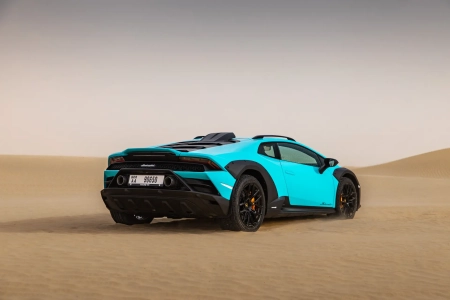
At the center of the Sterrato is the legendary 5.2-liter V10 engine, producing a raw, unadulterated 610 CV. In a world moving toward hybridization, this engine is a swan song for pure internal combustion. The roof-mounted air intake isn't just a stylistic choice; it’s a functional necessity, ensuring the engine breathes clean air even when the car is engulfed in a cloud of Sahara dust.
Visual Identity: Rugged Aesthetics Meets Italian Flair
Visually, the Sterrato is unmistakable. The bolt-on fender flares, the nose-mounted LED driving lights, and the Bridgestone Dueler AT002 run-flat tires signal its intent. It looks like something out of a post-apocalyptic film, yet it retains the sharp, hexagonal design language that makes a Lamborghini a work of art.
The Interior: Tactical Luxury
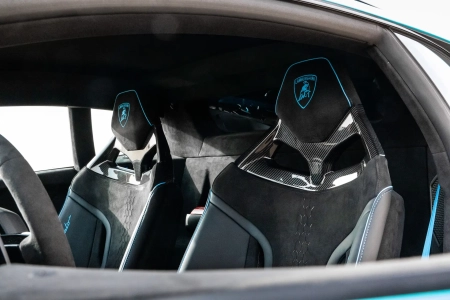
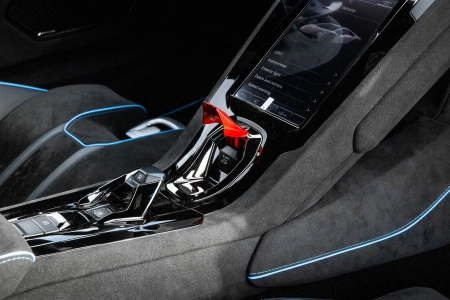
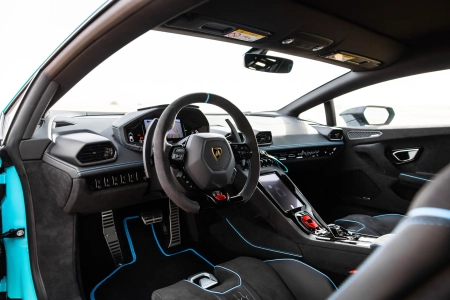
The cabin of the Sterrato reflects its "tactical" nature. Exclusive Alcantara Verde Sterrato upholstery provides grip during high-G maneuvers, while the HMI (Human Machine Interface) features new graphics including a digital inclinometer, a compass, and a geographic coordinate indicator. It is a cockpit designed for an explorer, not just a driver.
The Supercar That Refuses to Stay in Its Lane
For decades, supercars were fragile creatures, confined to the glass-smooth surfaces of racetracks and coastal highways. The Lamborghini Huracan Sterrato has shattered that paradigm. As the first "all-terrain" super sports car equipped with a V10 engine, the Sterrato is a glorious act of mechanical rebellion—a car designed to be driven hard where the asphalt ends and the dust begins.
Engineered for the Unthinkable
The Sterrato is not just a Huracan with a lift kit. It is a fundamental re-engineering of the LDVI (Lamborghini Integrated Vehicle Dynamics) system.
- Rally Mode: Specifically calibrated for low-grip surfaces, allowing for controlled oversteer that would be impossible in a standard EVO.
- Increased Ground Clearance: Raised by 44mm compared to the Huracan EVO, providing the necessary travel for gravel and dirt.
- Underbody Protection: Reinforced sills and a front aluminum underbody plate ensure the V10 remains protected from debris.
The Heartbeat: The Last of the Naturally Aspirated V10s
At the center of the Sterrato is the legendary 5.2-liter V10 engine, producing a raw, unadulterated 610 CV. In a world moving toward hybridization, this engine is a swan song for pure internal combustion. The roof-mounted air intake isn't just a stylistic choice; it’s a functional necessity, ensuring the engine breathes clean air even when the car is engulfed in a cloud of Sahara dust.
Visual Identity: Rugged Aesthetics Meets Italian Flair
Visually, the Sterrato is unmistakable. The bolt-on fender flares, the nose-mounted LED driving lights, and the Bridgestone Dueler AT002 run-flat tires signal its intent. It looks like something out of a post-apocalyptic film, yet it retains the sharp, hexagonal design language that makes a Lamborghini a work of art.
The Interior: Tactical Luxury
The cabin of the Sterrato reflects its "tactical" nature. Exclusive Alcantara Verde Sterrato upholstery provides grip during high-G maneuvers, while the HMI (Human Machine Interface) features new graphics including a digital inclinometer, a compass, and a geographic coordinate indicator. It is a cockpit designed for an explorer, not just a driver.